
OOUA Configuration Studio
OPC UA Information Model Configuration & Deployment Engineering
What is OOUA Configuration Studio?
OOUA Configuration Studio is the engineering and configuration environment of OOUAMiddleware, the model-driven industrial OPC UA integration platform developed by 4CE Industry.
It is designed to prepare industrial OPC UA runtime projects by combining information model instantiation, industrial connectivity configuration and data persistence configuration.
Rather than embedding equipment structures and communication mappings directly into application source code, OOUA Configuration Studio provides a model-driven approach to preparing an OPC UA runtime environment.
The resulting project is intended for execution by OOUA CoreServer, the native C/C++ runtime component of OOUAMiddleware.
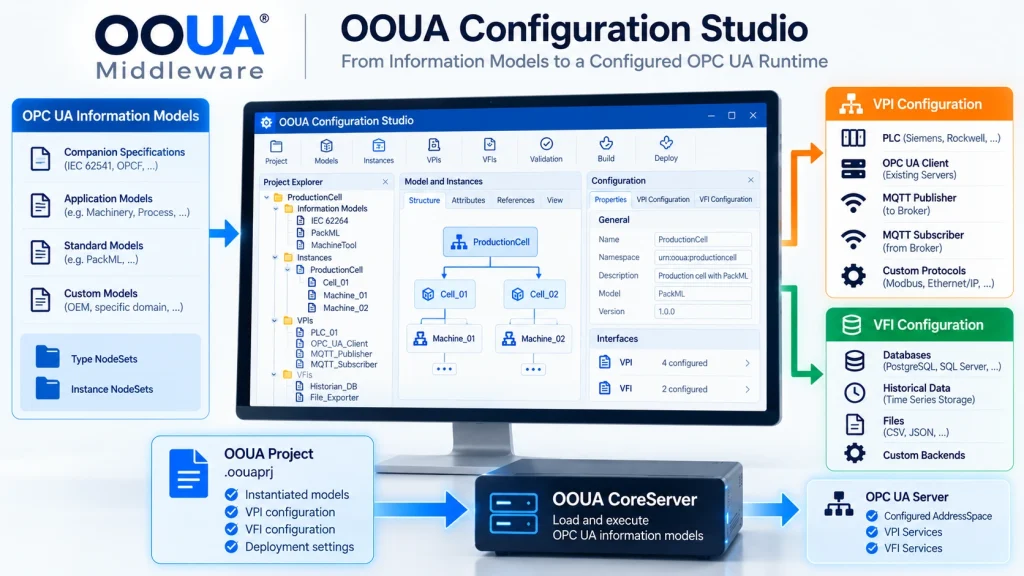
Figure 1 — OOUA Configuration Studio workflow: from OPC UA information models and runtime configuration to deployment with OOUA CoreServer.
From OPC UA Information Models to Runtime Instances
OPC UA information models define the types, structures and relationships used to represent industrial systems.
OOUA Configuration Studio works with these definitions to prepare the corresponding runtime instances.
Multiple OPC UA information models can coexist within the same AddressSpace, retaining their namespaces, type definitions and relationships.
This allows engineers to work with standardized Companion Specifications and application-specific models without requiring a single universal business model.
For further details on OPC UA types, instances and references, see our OPC UA Information Modeling overview.
Industrial Connectivity Configuration — VPI
Virtual Protocol Interfaces (VPIs) connect the OOUAMiddleware runtime to industrial equipment, controllers, existing servers and external communication systems.
OOUA Configuration Studio provides the engineering context for configuring these interfaces and associating industrial data sources with the configured OPC UA runtime model.
The VPI architecture supports heterogeneous industrial communication, including PLC protocols, OPC UA connectivity and MQTT Publisher and Subscriber interfaces.
The information model remains separate from the communication technology used to acquire or exchange data. The separation between industrial connectivity, the OPC UA runtime and persistence interfaces is detailed in the OPC UA Middleware Architecture.
Data Persistence Configuration — VFI
Virtual File Interfaces (VFIs) connect OOUAMiddleware to data persistence solutions.
OOUA Configuration Studio provides the configuration context for these interfaces, including the integration of industrial data storage and historical data services.
VFI interfaces are dedicated to persistence solutions, such as databases and file-based storage.
Communication with MQTT brokers is handled through VPIs, not VFIs.
Model-Driven Runtime Preparation
OOUA Configuration Studio brings together the configuration elements required by an OOUAMiddleware project:
- OPC UA information models and their runtime instances.
- Industrial communication interfaces (VPI).
- Data persistence interfaces (VFI).
- Runtime project configuration.
OOUA CoreServer then loads the configured project and executes the associated OPC UA information models, communication services and interfaces.
This separation distinguishes engineering configuration from runtime execution. The execution of configured information models is described in the OPC UA Runtime Model Architecture, which explains how NodeSet-based models are loaded and interpreted at runtime.
Supporting Native Digital Twin Architectures
The same OPC UA information model can be used to represent a virtual industrial system or a system connected to physical equipment.
An engineering workflow can therefore begin with a model instance, establish its intended structure and behavior, and subsequently associate it with industrial data sources.
The underlying information model does not need to be replaced when moving from a virtual representation to a connected deployment.
This approach provides a foundation for native digital twin applications based on OPC UA information models.
Configuration Studio and XiMulatorCore
OOUA Configuration Studio and XiMulatorCore address different engineering activities.
XiMulatorCore is a standalone OPC UA information model design tool. It supports Type NodeSet creation and editing, XMI 2.5 transformation, NodeSet2 XML import and export, Markdown documentation generation and multi-project management.
OOUA Configuration Studio focuses on preparing the runtime configuration of OOUAMiddleware, including model instantiation and the configuration of VPI and VFI interfaces.
Models produced with XiMulatorCore can be used within OOUAMiddleware, but XiMulatorCore is not a required runtime component.
Part of OOUAMiddleware
OOUAMiddleware combines OOUA Configuration Studio with OOUA CoreServer and its modular VPI and VFI interfaces.
Together, these components provide an engineering and runtime architecture for industrial OPC UA integration.
Developed by 4CE Industry — OpenOpcUa