
OPC UA Technical Ecosystem Around OOUAMiddleware
The OpenOpcUa Ecosystem is the OPC UA technical environment built around OOUAMiddleware, a complete industrial OPC UA implementation for model-driven, scalable and maintainable systems. It brings together the middleware core, the engineering workflow, the runtime architecture and the extension mechanisms required to build real industrial OPC UA systems.
What This OPC UA Technical Ecosystem Includes
Here, “ecosystem” does not mean a vague community or a set of surrounding initiatives. It refers to the technical environment built around OOUAMiddleware: modeling workflow, runtime architecture, extension mechanisms and deployment practices.
- OOUAMiddleware core — full OPC UA implementation and middleware foundation
- Modeling workflow — transformation from business/domain modeling to OPC UA NodeSets
- Runtime model — execution environment, configuration, deployment logic
- Integration modules — VPI/VFI add-ins for protocols, storage, and domain integration
- Deployment and operations — industrial execution, historization, lifecycle and maintainability
Why this ecosystem matters
Industrial OPC UA systems are not built from a protocol stack alone. They require a coherent environment linking modeling, runtime execution, integration modules and deployment practices. Without that continuity, projects tend to fragment into isolated tools, duplicated logic and brittle architectures.
In OpenOpcUa, the ecosystem is precisely this structured environment. It aligns the middleware core, the engineering workflow and the extension points so that systems can evolve without losing semantic consistency or architectural control.
The middleware core at the center
OOUAMiddleware is the technical core of the OpenOpcUa ecosystem. Around this core, the ecosystem organizes modeling practices, runtime execution, extension mechanisms and industrial deployment workflows. The objective is not to place isolated tools around a server, but to maintain a coherent technical environment in which models, runtime behavior and integration layers evolve together. Because this core is a real industrial middleware platform, the ecosystem is designed for model evolution, controlled integration, deployment continuity and long-term maintainability.
Full OPC UA foundation
A complete industrial OPC UA implementation designed as a durable technical base, not as a lightweight wrapper around isolated features.
Model-driven engineering
NodeSet-centered engineering keeps the information model explicit and allows the surrounding workflow to remain structurally consistent from design to execution.
Controlled extensibility
VPI and VFI modules extend connectivity, storage and runtime behavior without breaking the architectural integrity of the core platform.
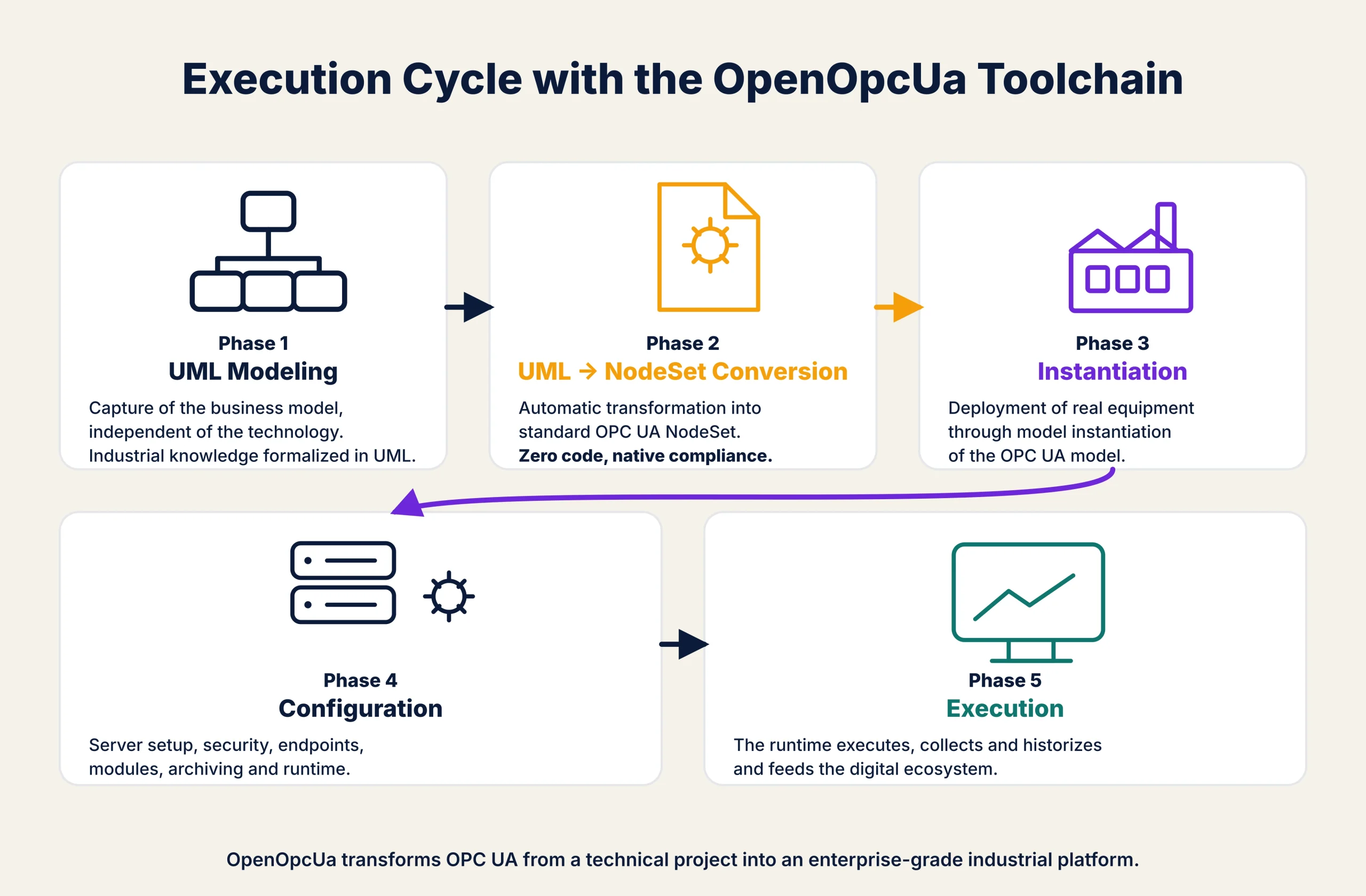
From Model to Runtime: the 5-Phase Toolchain
The OpenOpcUa ecosystem includes a complete engineering flow from business and domain modeling to NodeSet generation, instantiation, configuration and runtime execution. This workflow preserves the separation between model and runtime while making industrial deployment more traceable, scalable and maintainable.
Why it matters
- Models evolve without breaking deployments
- Reuse across projects and domains
- Consistent mapping to Companion Specifications
- Faster implementation and safer changes
- Scalability from prototype to deployment
What you get
- Engineering methodology aligned with OPC UA modeling practices
- Automation between artifacts
(UML → NodeSet → runtime instances) - Industrial deployment readiness
- Extensibility through add-ins and controlled integration points
This toolchain is a central part of the ecosystem because it connects engineering artifacts to runtime reality without collapsing everything into code. It allows models, generated NodeSets, instances and runtime configuration to remain aligned across the system lifecycle.
Modular Extensions and Integration Points
Within the OpenOpcUa ecosystem, extensibility is not an afterthought. It is organized through controlled integration points that allow protocol connectivity, historian services and domain-specific runtime behavior to be added without weakening the core architecture.
- Protocol connectivity through dedicated VPI modules
- Historian and storage integration through VFI extensions
- Custom runtime behaviors through controlled add-in mechanisms
- Domain-specific industrial integration without breaking the core architecture
A coherent technical environment
The OpenOpcUa ecosystem is not a loose collection of tools around OOUAMiddleware. It is a coherent technical environment that connects a middleware core, a model-driven engineering workflow, controlled extension mechanisms and industrial deployment practices. That coherence is what makes the ecosystem useful: it helps OPC UA systems remain structured, evolvable and maintainable over time.
Industrial Integration Ecosystem
The OpenOpcUa technical ecosystem can be implemented and extended by industrial software and integration companies working with OPC UA architectures.
YPERIA – OPC UA Software Integration
YPERIA provides industrial software development and OPC UA integration services, including OPC UA communication within industrial applications. OpenOpcUa and YPERIA are developing a technical collaboration around OPC UA integration and model-driven industrial architectures, with OOUAMiddleware as a potential integration platform.
Explore YPERIA’s OPC UA integration approach