
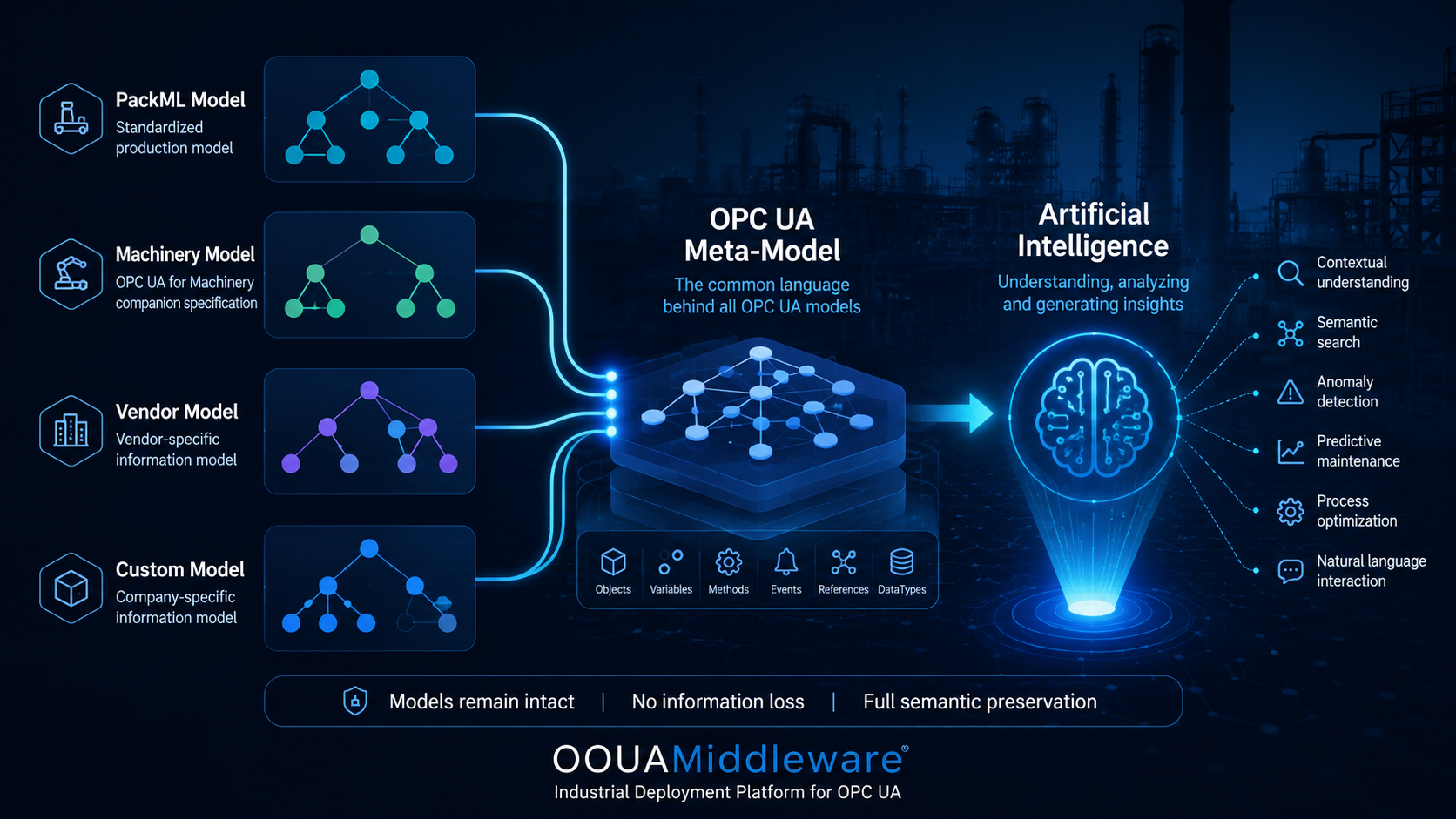
OPC UA and Artificial Intelligence
Understanding Different Models Through a Common Meta-Model
The Hidden Power of the OPC UA Meta-Model
Artificial Intelligence is rapidly becoming a major topic in industrial automation.
Large Language Models (LLMs), Retrieval-Augmented Generation (RAG), Digital Twins, and Agentic AI are creating new opportunities for analyzing, understanding, and interacting with industrial systems.
However, AI systems have one fundamental requirement:
They need context.
Without context, data is just data.
A temperature value of 42 means nothing unless we know what it represents, where it comes from, how it relates to other information, and what role it plays within a process.
This is where OPC UA offers a unique advantage.
The Real Challenge Is Not Data Access
For decades, industrial projects have focused on collecting data.
Communication protocols, historians, databases, and dashboards have made industrial information more accessible than ever.
The problem today is different.
The challenge is no longer:
How do we access the data?
The challenge is:
How do we understand the data?
Most industrial systems still expose information as tags, database fields, or protocol variables.
Examples such as:
- DB100.DBD12
- PLC1.Tag567
- Sensor_245_Value
may be meaningful to the original developer, but they provide very little information to an AI system.
The meaning exists only in human documentation and engineering knowledge.
AI Requires Structure
Modern AI systems perform best when information is organized into meaningful relationships.
For example, an AI can easily understand the following structure:
Pump
├── Speed
├── Flow
├── Temperature
└── Status
The AI immediately understands that:
- the object is a pump,
- speed, flow, and temperature are properties of the pump,
- status represents the operating condition of the equipment.
The structure itself carries meaning.
This is exactly what OPC UA was designed to provide.
OPC UA Is More Than a Communication Protocol
OPC UA is often described as a communication standard.
While this is true, it is only part of the story.
OPC UA is also a complete information modeling framework.
It provides:
- ObjectTypes
- VariableTypes
- ReferenceTypes
- DataTypes
- Methods
- Events
- Inheritance
- Composition relationships
These concepts allow industrial systems to describe not only data values but also their meaning and relationships.
In other words, OPC UA provides a machine-readable semantic model.
This semantic layer is becoming increasingly valuable in the age of Artificial Intelligence.
Why OPC UA Is Naturally Compatible with AI
Unlike traditional industrial communication approaches, OPC UA does not expose isolated variables.
It exposes structured information models.
An AI system can navigate:
- equipment hierarchies,
- relationships between objects,
- data definitions,
- engineering semantics,
- operational context.
Instead of discovering disconnected values, the AI discovers a coherent representation of the industrial system.
This dramatically improves the quality of reasoning, search, contextualization, and decision support.
The result is not simply more data.
The result is better understanding.
The Common Misconception: A Single Industrial Model
As Artificial Intelligence enters industrial environments, a common assumption often appears:
To make AI successful, the industry needs a single universal model.
In practice, this assumption is unrealistic.
Many information models already exist:
- PackML
- OPC UA for Machinery
- Euromap
- ISA-95 based models
- Vendor-specific models
- Company-specific models
Each of these models addresses different business requirements.
Replacing them with a new universal model would create significant complexity and potentially lose valuable domain knowledge.
Fortunately, OPC UA offers a different path.
The Hidden Strength of OPC UA: The Meta-Model
The real power of OPC UA is not that every system uses the same information model.
The real power is that all OPC UA information models are built on the same OPC UA meta-model.
Regardless of the application domain, every OPC UA model relies on the same fundamental building blocks:
- Objects
- Variables
- Methods
- Events
- References
- Types
This means that different information models can coexist while remaining understandable.
The models may be different.
The language used to describe them is the same.
For Artificial Intelligence, this is a major advantage.
An AI does not need every system to use the same model.
It only needs a consistent way to understand the models that already exist.
The OPC UA meta-model provides exactly that capability.
Preserving Existing Models Instead of Replacing Them
Industrial companies have invested years developing and refining their information models.
These models contain valuable operational knowledge.
The goal should not be to replace them.
The goal should be to preserve them while making them accessible and understandable.
This is one of the key strengths of the OPC UA approach.
Different models can coexist.
Different business domains can coexist.
Different vendors can coexist.
The common foundation remains the OPC UA meta-model.
Why This Matters for the Future of Industrial AI
As AI systems become more capable, the quality of their results will increasingly depend on the quality of the underlying information structures.
Raw data alone is not enough.
Context matters.
Relationships matter.
Semantics matter.
Industrial organizations that expose their systems through rich OPC UA information models are building a foundation that AI systems can understand, navigate, and exploit.
This is one of the reasons why OPC UA is uniquely positioned for the next generation of industrial intelligence.
The Role of OOUAMiddleware
OOUAMiddleware was designed around the OPC UA meta-model.
Rather than imposing a proprietary information model, it preserves and exploits existing OPC UA models.
By dynamically loading and instantiating OPC UA NodeSets, OOUAMiddleware enables multiple information models to coexist within the same environment while maintaining their original semantics.
This approach allows applications, integrations, analytics platforms, and future AI systems to interact directly with structured industrial knowledge rather than isolated data points.
The objective is not to create a new universal model.
The objective is to leverage the common language already provided by OPC UA.
Conclusion
Artificial Intelligence does not require a new industrial language.
It requires systems that can describe themselves clearly.
OPC UA already provides the foundations for this capability through its information modeling framework and its meta-model.
The future of Industrial AI is unlikely to be built on a single universal information model.
It will be built on the ability to understand, navigate, and exploit many different models.
This is precisely what the OPC UA meta-model was designed to enable.