
The 5 Architectural Mistakes When Choosing an OPC UA Server
OPC UA has become the standard industrial interoperability platform.
Today, dozens of products are marketed as OPC UA servers, and selecting one may appear straightforward.
However, a frequent mistake is to assume that all OPC UA servers solve the same architectural problem.
In reality, OPC UA servers available on the market fall into very different categories, each designed for a specific role within industrial architectures.
Choosing the wrong category can introduce long-term limitations in scalability, maintainability, and information modeling.
This article highlights five common architectural mistakes when selecting an OPC UA server.
Mistake 1 — Confusing Connectivity with Architecture
Many OPC UA servers are primarily connectivity platforms.
Their core objective is to:
- connect industrial devices
- collect data from PLCs and equipment
- expose variables through OPC UA
Examples include:
- Kepware KEPServerEX
- Software Toolbox TOP Server
- Softing dataFEED
These solutions are excellent industrial data gateways.
However, their configuration model typically remains tag-based.
The architectural limitation
Tag-based approaches do not naturally scale to complex industrial information models involving:
- equipment hierarchies
- structured assets
- reusable domain models
- companion specifications
Connectivity is essential, but architecture requires more than connectivity.
Mistake 2 — Using Migration Gateways as Core Infrastructure
Some OPC UA servers are designed primarily for OPC Classic migration.
Typical example:
- Unified Automation UaGateway
Their role is to translate legacy protocols such as:
- OPC DA
- OPC AE
- OPC HDA
into OPC UA.
This is extremely useful for modernizing existing infrastructures.
The architectural limitation
Migration gateways are protocol bridges, not industrial middleware.
They are optimized for compatibility, not for structuring new information architectures.
Using them as the central OPC UA infrastructure may limit long-term evolution.
Mistake 3 — Relying on Embedded OPC UA Servers
Many automation platforms embed an OPC UA server.
Examples include:
- Ignition OPC UA Server
- CODESYS OPC UA Server
- PLC-integrated OPC UA implementations
These servers are tightly integrated with:
- SCADA environments
- PLC runtimes
- automation platforms
The architectural limitation
Embedded servers are optimized for their host environment.
They may not be designed to act as independent industrial middleware layers capable of structuring complex cross-system architectures.
Mistake 4 — Treating OPC UA as a Simple Data Protocol
One of the most common misunderstandings is treating OPC UA as merely a modern communication protocol.
While OPC UA server indeed provides secure data exchange, its real power lies in:
- structured information modeling
- semantic interoperability
- companion specifications
- extensible address spaces
Using OPC UA only as a variable transport layer prevents organizations from leveraging its full architectural potential.
Mistake 5 — Ignoring Information Model Architecture
Large-scale industrial systems require structured modeling of:
- assets
- processes
- equipment
- production systems
Without a coherent information model architecture, OPC UA address spaces quickly become:
- inconsistent
- difficult to maintain
- hard to evolve
The challenge is not only exposing variables but organizing industrial knowledge in a structured address space.
A Different Approach: OPC UA Middleware
A new architectural category is emerging in the OPC UA ecosystem:
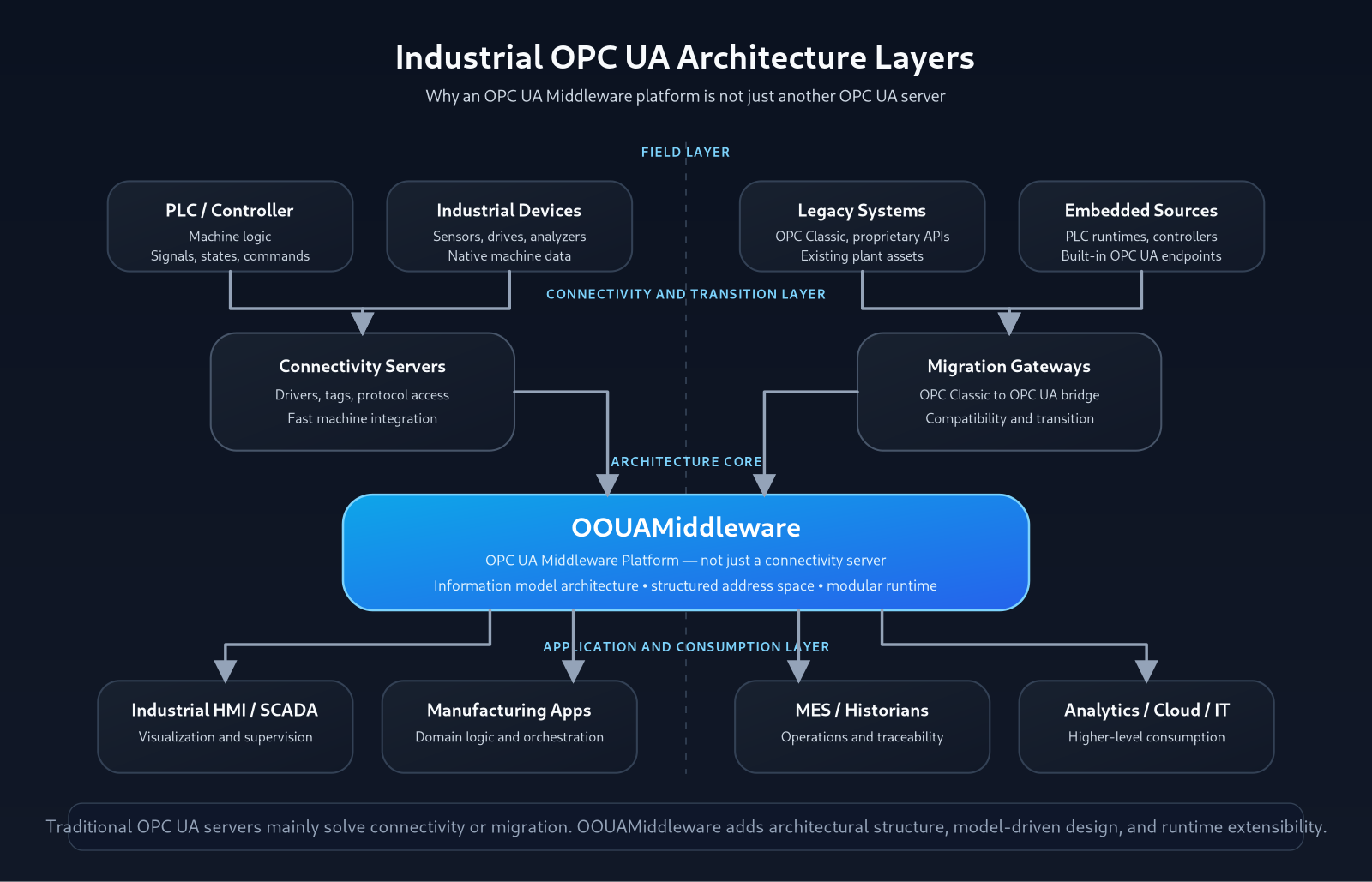
OPC UA middleware platforms.
Instead of focusing only on connectivity, these platforms address:
- information model architecture
- structured instantiation of industrial assets
- lifecycle management of address spaces
- modular extensibility
They aim to transform OPC UA into a true industrial software platform.
OpenOpcUa and OOUAMiddleware
OpenOpcUa was created with this architectural perspective.
OOUAMiddleware is not simply an OPC UA server.
It is a complete OPC UA middleware platform designed to support industrial architectures.
Its approach is based on:
- model-driven address space generation
- separation between modeling and runtime
- modular extensions through VPI and VFI modules
- industrial-grade OPC UA runtime implementation
This architecture allows OPC UA to become the foundation of industrial software systems, rather than just a communication interface.
Choosing the Right OPC UA Technology
When evaluating OPC UA technologies, it is essential to identify the architectural role required.
| Technology category | Typical purpose |
| Connectivity servers | Device connectivity |
| Migration gateways | OPC Classic modernization |
| Embedded servers | Platform integration |
| Simulation servers | Development and testing |
| OPC UA middleware | Industrial architecture platform |
Understanding these distinctions enables engineers and system architects to design scalable, maintainable OPC UA infrastructures.
Conclusion
OPC UA servers play an essential role in industrial interoperability.
But selecting a technology based only on the label “OPC UA server” can lead to architectural limitations.
The key question is not only:
“Does it support OPC UA?”
but rather:
“What architectural role does this technology play?”
Explore the OpenOpcUa Architecture
4CE INDUSTRY