
OPC UA Middleware Architecture
Model-Driven Runtime Architecture for Industrial OPC UA Systems
Architecture-first implementation of IEC 62541, driven by OPC UA information modeling and runtime execution.
OPC UA Middleware Architecture Overview
The OPC UA middleware architecture implemented in OOUAMiddleware is designed for long-term industrial scalability, strict IEC 62541 compliance and semantic information modeling. OPC UA enables interoperability at scale only when implementations preserve architectural consistency.
In real industrial deployments, interoperability degrades when systems rely on shortcuts, hard-coded structures or ad-hoc data mapping. OOUAMiddleware follows an architecture-first approach with clear separation between information structure, runtime services and extension mechanisms, allowing the platform to evolve without structural redesign.
For a broader definition of the role of middleware in industrial systems, see OPC UA Middleware.
Model-Driven Runtime Architecture
OOUAMiddleware is built on a model-driven runtime architecture where OPC UA information models define the semantic structure of the system and directly drive the AddressSpace. Instead of embedding business structures into application code, OpenOpcUa relies on NodeSet definitions to materialize and evolve the exposed information model at runtime. This approach keeps the semantic structure explicit, auditable and aligned with IEC 62541, while preserving a clear separation between the domain model and the runtime engine. The model defines objects, relationships and constraints; the runtime core ensures service compliance, security, performance and execution stability. This separation allows industrial systems to evolve without forcing structural redesign of the OPC UA core.
The Runtime loads Model NodeSets (types) and Deployment NodeSets (instances) to materialize and execute the AddressSpace — without a compile step.
The architecture enforces a strict separation between the domain model and the runtime execution engine. The semantic model defines industrial structure, relationships, and constraints, while the runtime core ensures service compliance, performance, security, and session management. This separation is fundamental in a robust OPC UA middleware architecture: it allows the industrial logic to evolve independently from the communication stack. By decoupling semantic modeling from runtime services, OOUAMiddleware guarantees maintainability, architectural clarity, and long-term scalability in complex industrial environments. Data acquisition and historical persistence are architecturally integrated components of the middleware, not external add-ons.
Modular Extension Through VPI and VFI
Industrial systems require controlled extension points for connectivity, archiving and domain-specific behavior. OOUAMiddleware provides this through a modular add-in architecture based on VPI (Virtual Process Interface) and VFI (Virtual Function Interface). These mechanisms allow protocol drivers, acquisition modules, archival back-ends and business-specific processing layers to be integrated without modifying the runtime core.
This design keeps the OPC UA middleware architecture stable while allowing functional evolution over time. Instead of embedding industrial logic directly into the communication layer, extensions remain encapsulated behind explicit interfaces. The result is a more maintainable architecture, better long-term consistency, and extensibility that does not break IEC 62541 service integrity.
VPI and VFI provide explicit extension ports, while the OOUACoreServer keeps IEC 62541 service integrity — Lua enables evolutive domain behavior.
Because the architecture natively integrates NodeSet-based modeling, OOUAMiddleware can support proprietary information models as well as official OPC Foundation Companion Specifications such as PackML, Robotics, Machine Tools or Energy models. The result is a semantically consistent and evolution-ready industrial information platform.
According to the OPC Foundation, OPC UA provides a platform-independent service-oriented architecture for industrial interoperability.
Built for Industrial Constraints
- Long lifecycle deployments
- Runtime stability and deterministic behavior
- Scalable AddressSpace and subscriptions
- Redundancy and resilience patterns
- Security aligned with the OPC UA model
Difference Between an SDK and a True OPC UA Middleware Architecture
Unlike lightweight SDKs that primarily expose APIs to implement OPC UA communication, an OPC UA middleware architecture provides a complete, structured execution environment. An SDK typically focuses on protocol access — encoding, decoding, services, sessions — leaving architectural decisions, information modeling, lifecycle management, and scalability entirely to the developer. In contrast, OOUAMiddleware integrates modeling, runtime services, extensibility mechanisms, and industrial robustness within a coherent architectural framework. It is not a toolkit; it is a fully structured middleware layer designed to support long-term industrial deployments without structural redesign.
Through this architecture, OpenOpcUa enables the construction of full industrial OPC UA platforms while preserving strict architectural integrity and long-term maintainability.
Three Architectural Approaches to OPC UA Implementation
OPC UA systems can be implemented using fundamentally different architectural approaches.
While they may appear similar at first glance, they differ significantly in how the information model is handled and executed.
The key distinction lies in the relationship between the information model and the runtime system.
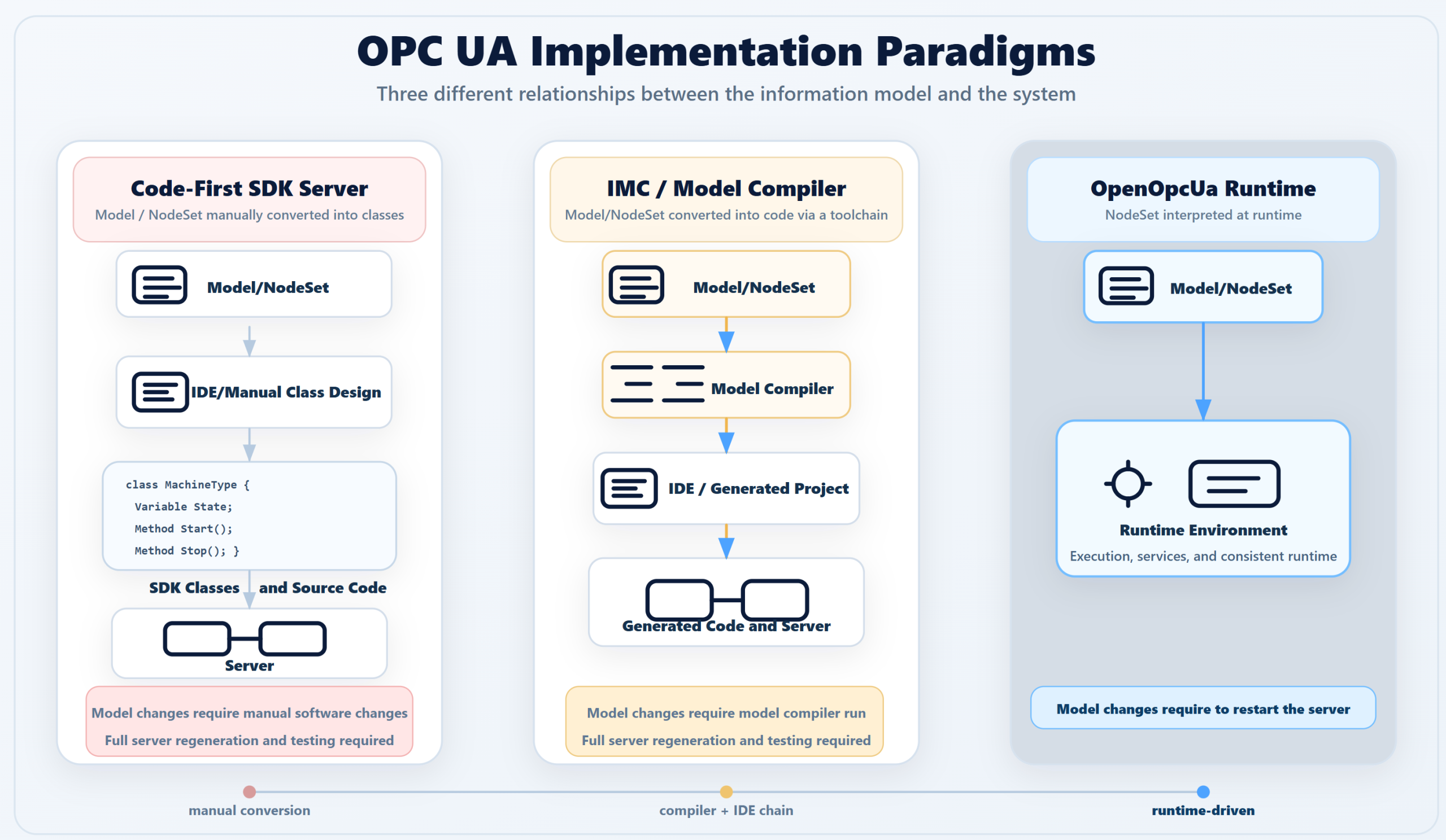
Three OPC UA implementation paradigms: Code-First, Model Compiler (IMC), and OpenOpcUa Runtime.
The Real Difference: Cost of Model Evolution
The fundamental difference between these approaches is not in features, but in how they handle changes in the information model.
- Code-First SDK Server: any model change requires manual code modification, rebuild, and full validation of the server.
- Model Compiler (IMC): the model must be recompiled into code, re-integrated, and redeployed through a development toolchain.
- OpenOpcUa Runtime: the model is interpreted at runtime; updating the system only requires loading the new model and restarting the server.
This difference directly impacts system agility, maintenance cost, and long-term scalability.
From Development-Driven to Model-Driven Architecture
Traditional OPC UA implementations are development-driven: the information model is tightly coupled to the software implementation.
OpenOpcUa introduces a different paradigm: a runtime-driven architecture where the information model directly drives system behavior without code generation.
This enables a clear separation between modeling and implementation, significantly reducing dependency on development cycles.
Discuss an Architecture Baseline
If you are defining a domain-specific model, integrating Companion Specifications or designing a multi-system OPC UA architecture, a structured technical discussion helps preserve semantic consistency and long-term interoperability.