
OOUAMiddleware – Industrial OPC UA Middleware Platform
A semantic-model-driven industrial OPC UA platform for integration, execution and archiving.
What is OOUAMiddleware?
OOUAMiddleware is a semantic-model-driven industrial OPC UA middleware platform built on strict IEC 62541 compliance. It unifies heterogeneous industrial data sources, adapts to structured OPC UA information models and delivers modular runtime capabilities for demanding environments.
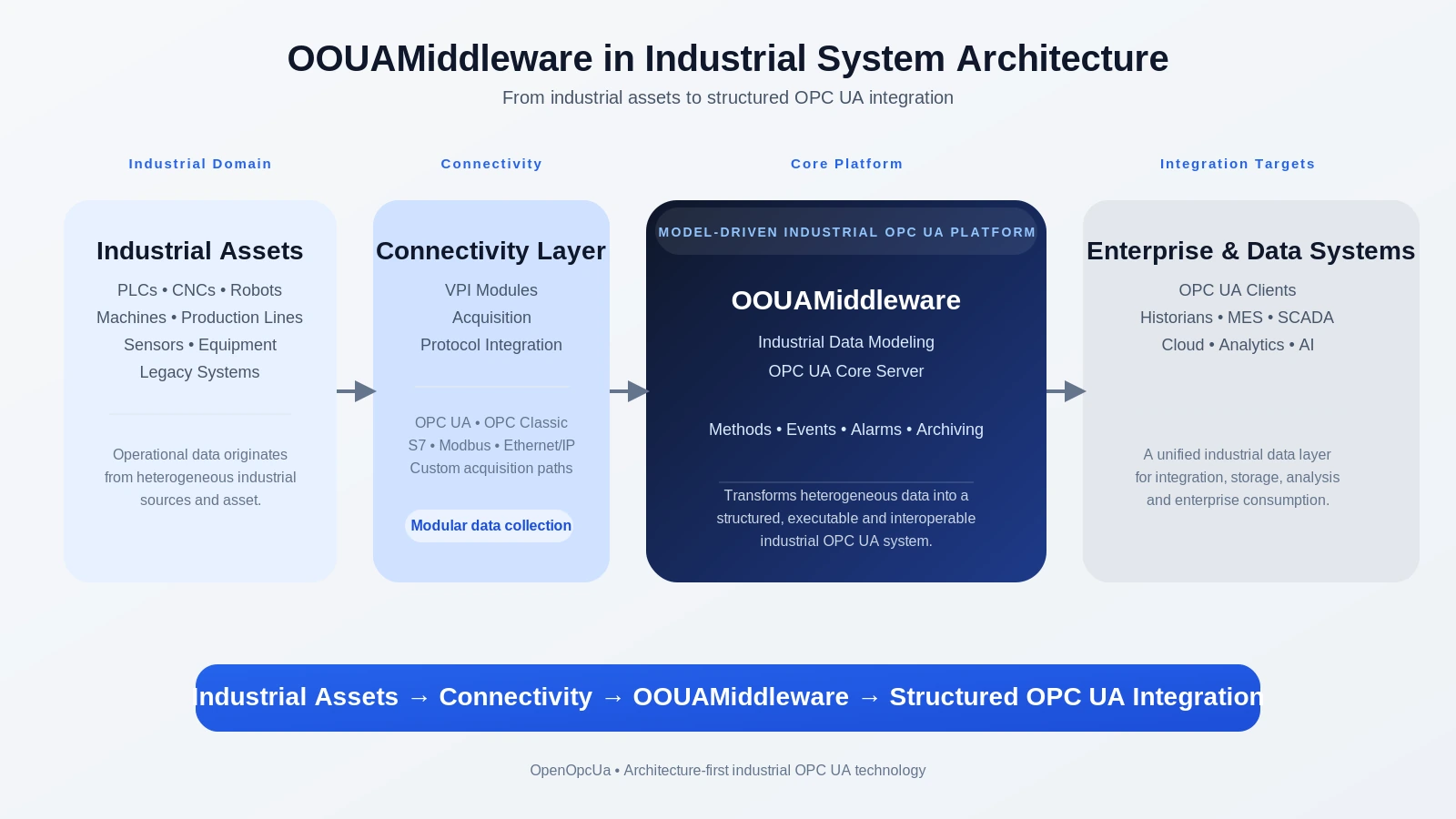
OOUAMiddleware integrates industrial assets, protocols and enterprise systems through a model-driven OPC UA middleware architecture.
What is an OPC UA Middleware?
An OPC UA middleware is a software platform that sits between industrial systems and enterprise applications.
Unlike a traditional OPC UA server, which exposes data from a single system, an OPC UA middleware integrates multiple industrial data sources, structures them through a consistent information model, and exposes a unified OPC UA interface for enterprise systems.
Typical responsibilities of an OPC UA middleware include:
- protocol integration and data acquisition
- aggregation of multiple OPC UA servers
- industrial information modeling
- event, alarm and historical data management
- integration with enterprise systems such as MES, databases or cloud platforms
OOUAMiddleware implements this concept through a model-driven architecture, allowing industrial data systems to be built and executed from structured OPC UA models.
Designed for Complex Industrial Environments
- Multi-protocol integration
- IT/OT convergence
- Long lifecycle industrial systems
- High availability requirements
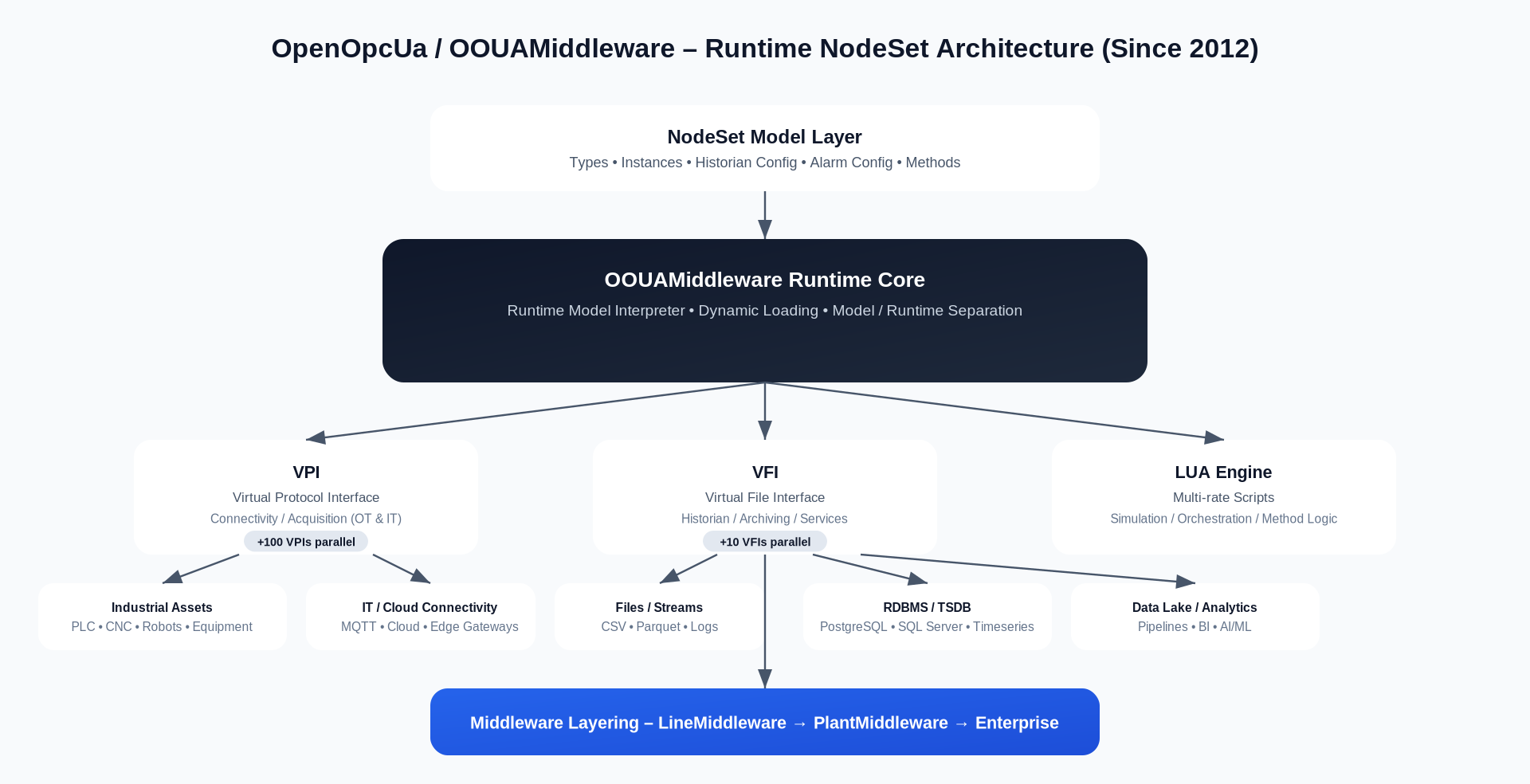
Core Capabilities of the Platform
- OPC UA Server & Client Stack
- Modular Connectivity Drivers
- Dynamic AddressSpace from NodeSet XML
- Redundancy mechanisms
- Structured Information Modeling
- Companion Specification integration
- Flexible Archiving (SQL, Parquet, Binary)
- Extensible Plug-in Architecture
Platform Architecture Overview
OOUAMiddleware is built around structured OPC UA information models that define the semantic structure of the system. These models are created using official Companion Specifications or a dedicated industrial modeling methodology.
The semantic layer drives the runtime core, industrial connectors and archiving modules.
Industrial Protocol Integration
OOUAMiddleware is designed to integrate heterogeneous industrial data sources through a modular driver architecture. Data acquisition is handled by dedicated collection modules, allowing protocols to be added, updated or replaced without impacting the OPC UA core runtime or the information modeling layer.
The platform can act as an industrial data concentrator, mapping field-level data into structured OPC UA information models and exposing it through a consistent semantic interface.
Typical industrial integration scenarios include:
- PLC and field device acquisition through modular protocol drivers
- OPC UA aggregation and gateway architectures
- OPC Classic wrapping for legacy environments
- Incremental modernization where protocols coexist during migration phases
Supported and commonly used protocol modules include Modbus, Siemens S7 and EtherNet/IP, as well as OPC UA and legacy OPC Classic integration. Additional drivers can be implemented following the same modular principles, preserving long-term maintainability and strict IEC 62541 alignment.
Flexible Industrial Data Storage
OOUAMiddleware provides flexible and modular data storage mechanisms adapted to diverse industrial architectures.
Historic and operational data can be persisted using different storage backends depending on performance, traceability and analytics requirements. Supported storage options include relational SQL databases, structured file exports (CSV), native binary formats and high-efficiency columnar formats such as Apache Parquet for large-scale analytics environments.
The storage layer is fully decoupled from the runtime core. This separation allows organizations to evolve their data strategies — including integration with data lakes or cloud-based systems — without modifying the semantic information model or the OPC UA server layer.
OOUAMiddleware also supports OPC UA Historical Access, ensuring standardized access to archived industrial data in compliance with IEC 62541.
Deployment & Usage Model
OOUAMiddleware is available for industrial deployment without runtime licensing fees. Deployment does not imply transfer of intellectual property. The technology remains under the control of its original author.
Structured technical sponsorship and industrial support programs are operationally managed through 4CE Industry.
Why Choose OOUAMiddleware?
- Semantic interoperability
- Architecture-first design
- Strict IEC 62541 alignment
- Modular extensibility
- Industrial-grade robustness
When to choose OOUAMiddleware
- When you need to integrate heterogeneous industrial protocols into a unified OPC UA information model
- When your system architecture requires a middleware layer between machines and enterprise systems
- When an OPC UA server alone is not sufficient to structure and orchestrate industrial data
- When multiple OPC UA servers must be aggregated and exposed through a consistent industrial information model
- When migrating from OPC Classic to a modern OPC UA architecture
- When implementing a model-driven industrial data platform
Typical industrial scenarios
- Industrial Data Integration Layer
Integrating PLCs, machines and field systems into a unified OPC UA architecture. - OPC Classic Migration Gateway
Replacing legacy OPC Classic infrastructures with modern OPC UA systems. - Industrial Data Historization Platform
Collecting, structuring and archiving industrial process data. - Model-Driven OPC UA Architecture
Implementing structured OPC UA information models across industrial systems. - Industrial Edge Integration
Connecting machines to MES, cloud platforms or analytics pipelines.
OOUAMiddleware vs OPC UA Servers
| OPC UA Server | OOUAMiddleware |
|---|---|
| Expose data from a single system | Integrates multiple systems |
| Static AddressSpace | Dynamic model-driven architecture |
| Limited integration capabilities | Modular connectivity (VPI) |
| Basic historical access | Advanced data collection and archiving |
Discuss Your Industrial OPC UA Architecture
Industrial OPC UA deployments require more than protocol connectivity.
They demand structured information modeling, architectural consistency and long-term interoperability aligned with IEC 62541 principles.
Whether you are defining a new domain-specific information model, integrating Companion Specifications or designing a multi-system OPC UA architecture, a structured technical discussion ensures that modeling decisions and runtime behavior remain aligned.
Operational support, architectural guidance and structured technical sponsorship programs related to OOUAMiddleware are provided through 4CE Industry.