
Industrial OPC UA Technology
Architecture, Modeling and Runtime for Industrial OPC UA Systems
Industrial OPC UA Technology
OpenOpcUa provides a complete industrial OPC UA technology stack.
Beyond simple SDKs or protocol implementations, the project focuses on the architectural foundations required to build scalable industrial systems.
The OpenOpcUa approach combines three essential dimensions:
- Architecture – structuring industrial information models and address spaces
- Modeling – designing consistent and scalable OPC UA information models
- Runtime execution – connecting models to operational logic and system behavior
Together these elements form a coherent technological foundation for industrial OPC UA systems.
OpenOpcUa Technology Overview
OpenOpcUa combines information modeling, runtime execution and middleware integration to build scalable industrial OPC UA systems. The following diagram illustrates the core technological structure.
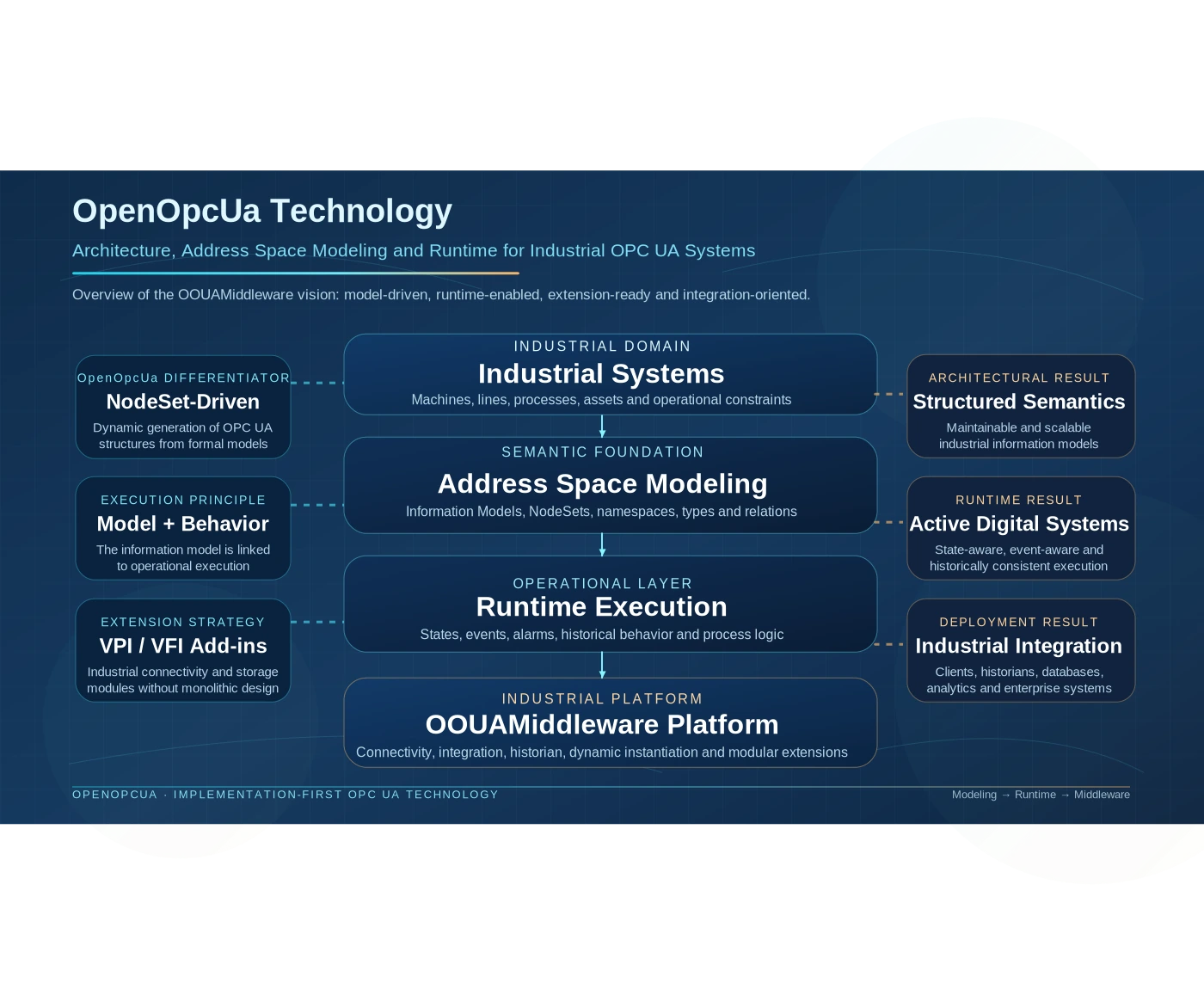
OpenOpcUa Technology Overview – Architecture combining OPC UA information modeling, runtime execution and industrial middleware integration.
Download the SVG version of this diagram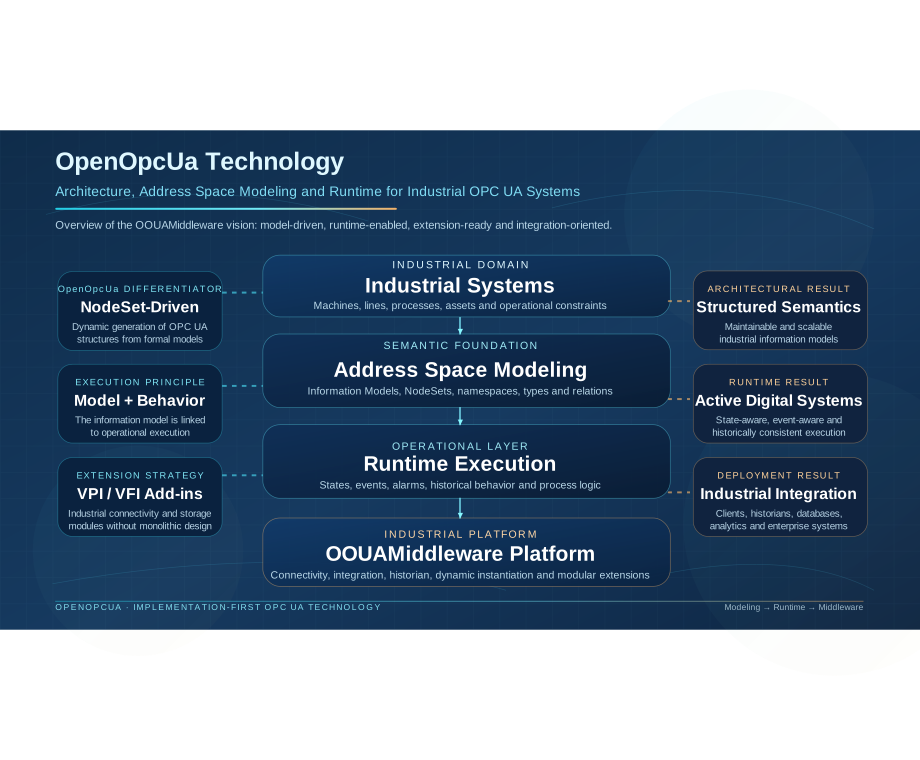
Architecture and Information Modeling
Industrial OPC UA systems are built on a structured information model known as the Address Space.
The address space is not merely a container of variables; it represents the semantic structure of the industrial system.
Designing a consistent address space requires:
- clear type hierarchies
- well-structured namespaces
- reusable information models
- explicit relationships between objects
A strong architectural foundation ensures that OPC UA systems remain maintainable, scalable and interoperable across industrial environments.
Runtime Execution Model
Industrial systems require more than a static information model.
They require an execution layer capable of managing system behavior, events and operational logic.
The OpenOpcUa runtime model connects the OPC UA information model to the operational layer of the system.
It allows the address space to interact with processes, state machines and industrial events.
This execution layer enables OPC UA models to become active representations of industrial systems rather than passive data structures.
Industrial OPC UA Middleware
OOUAMiddleware is the industrial implementation of the OpenOpcUa technology.
Rather than providing a simple OPC UA server, the middleware platform integrates multiple architectural components required in real industrial deployments:
- connectivity to industrial systems
- integration of heterogeneous data sources
- historical data management
- scalable address space generation
- modular extension through add-ins
This middleware layer enables the deployment of OPC UA architectures across industrial environments.
Common OPC UA Architecture Mistakes
Many OPC UA deployments fail not because of the protocol itself but because of architectural design decisions.
Typical mistakes include:
- treating OPC UA as a simple communication protocol
- exposing raw variables instead of structured models
- coupling operational logic directly to the server implementation
- building monolithic OPC UA servers instead of scalable architectures
Understanding these pitfalls is essential when designing industrial OPC UA systems.
OPC UA Technical Knowledge Base
The OpenOpcUa website provides a collection of technical articles dedicated to OPC UA architecture, modeling strategies and industrial implementations.
These articles explore practical challenges encountered in real industrial systems and provide architectural guidance for building robust OPC UA infrastructures.
Explore the OpenOpcUa Technology
The OpenOpcUa project demonstrates how OPC UA can be used as a foundation for scalable industrial architectures.
By combining architecture, modeling and runtime execution, OpenOpcUa provides a coherent technological framework for building industrial OPC UA systems.